
About half the water in Metro Denver comes from the Colorado River. Not the South Platte. It gets hauled east under the Continental Divide through tunnels, somewhere between 450,000 and 600,000 acre-feet a year, enough to bury this whole metro area five feet deep. Most people don’t think about how water gets to the tap, but they sure as shit expect it to flow when they turn the tap.
Here’s why that matters right now.
Back in 1922 seven states signed a compact splitting up the Colorado River, and Article III(d) requires the Upper Basin, meaning us, to not deplete the flow below 75 million acre-feet every ten years at Lee Ferry. Rain or shine. Colorado signed up to be the guarantor. The problem is they set those numbers off two decades that turned out to be one of the wettest stretches in five centuries, according to tree ring reconstructions funded in part by the Bureau of Reclamation itself. The river they promised out doesn’t exist and never really did.
Colorado water law runs on seniority, oldest right gets first, and nearly every Front Range diversion was built after 1922. That makes our water junior to the compact. A study sponsored by the Colorado River District and the Southwestern Water Conservation District found that if the Lower Basin ever forces the issue and the state hasn’t banked more water in Lake Powell, the Front Range could lose up to 97 percent of its Colorado River supply. Water for more than a million homes.
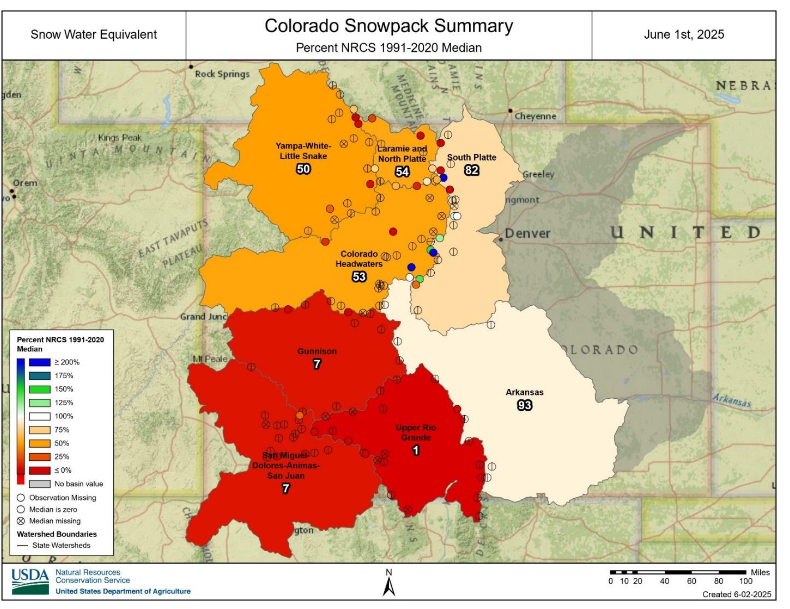
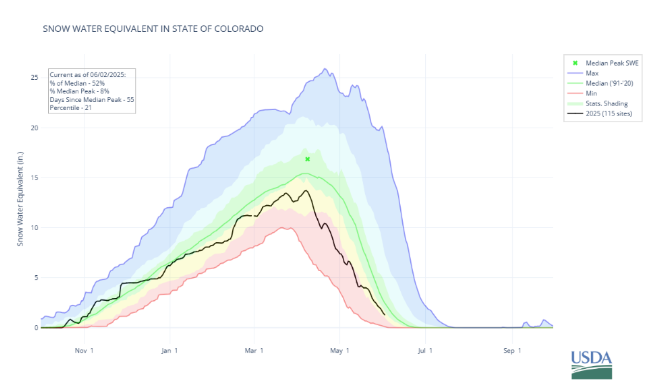
Now look at this shit. Statewide snowpack hit 14 percent of median on June 1, third lowest June in the entire NRCS record. Governor Polis declared a statewide drought emergency on June 4, the top tier of the state’s response plan, every county included. Lake Mead set an all time low last week. Lake Powell is sitting about 31 feet above the elevation where Glen Canyon Dam stops making power, and that dam feeds 28 Colorado utilities. Don’t worry though, we can handle more data centers, and GEO group housing more ICE detainees.
And here’s the fucked part.
What an acre-foot of Colorado River water costs
Imperial Irrigation District farmers pay
Cities pay, on average
The federal government pays that same district not to use it
Nearly a quarter of the water delivered to ag districts in California, Arizona and Nevada costs zero dollars. Free coming in, premium going out, your tax dollars on both ends. Yea I just don’t get why we let this deal go on, we have the ability to force other states to help create more water supply and we don’t. Oh yea, in case you were like me and did not know. One acre-foot is about 326,000 gallons.
Free water going down, premium payments coming back, for water we were legally forced to send them in the first place.
So Colorado is now standing up its own conservation program for 2027 and 2028 with $100 million in federal money (that won’t even make a slight dent). Payment rates, who qualifies, how the money gets split, none of it is settled. The Colorado Water Conservation Board finalizes the criteria at its September 16 and 17 board meeting. Schedule and materials are at cwcb.colorado.gov/board-meetings, and they stream live on YouTube. Written comment goes to Viola.Bralish@state.co.us or straight to board chair Barbara Vasquez.
The people already working those rules are the Western Slope water districts, the irrigation associations, the Farm Bureau, Conservation Colorado, Western Resource Advocates. Every one of them is doing their job by showing up. Nobody is showing up for us.
Which brings me to the thing almost nobody in this metro knows exists. Colorado has nine Basin Roundtables, created by the legislature in 2005 under the Water for the 21st Century Act specifically so regular citizens would have a formal seat in water decisions. They feed into the state water plan and they hand out real grant money through the Water Supply Reserve Fund. Ours is the Metro Basin Roundtable, and it’s the only one in the state not drawn around a natural river basin, because our situation is its own animal.
The state’s own projection for that animal: metro Denver needs an additional 183,000 to 272,000 acre-feet by 2050, and that figure already assumes we conserve. South Metro needs another 25,900 just to replace the non-renewable Denver Basin groundwater we’re currently mining.
Your seat is already there
Metro Basin Roundtable
Thursday, August 13 · 2–4pm
Hybrid. Denver Water Administration Building, or join on Zoom.
- Item 4 on the agenda is Public Comment. Every meeting. Five minutes that belongs to whoever shows up.
- One of nine roundtables created by the legislature in 2005 so citizens would have a formal say.
- They feed the state water plan and hand out real grant money.
- No credentials required. Two hours and an internet connection.
Staff contact: Jeff Rodriguez, CWCB.
Also on the calendar
- Wed, August 19, 2–4pm — Colorado River Contribution Program Workshop, Colorado Water Congress
- Mon, August 24, 2–4pm — Drought Task Force Meeting #5
- Sept 16–17 — CWCB Board Meeting, where the $100M conservation criteria get set
You don’t need credentials for any of this. You need two hours and an internet connection.
I’ve got a longer piece coming on how a hundred year old contract signed off with shit math ended up with us on the hook. But the meeting is Thursday, so this part couldn’t wait.