
Following the Money in Local Government
Palm Beach Counties data center project.
So while researching about the Massive amount of money Palm Beach County had invested in Israel I saw an article pop up about a data center that had been proposed to be built in the county. Of course it immediately got confusing, I started to feel like I was looking more into the affects of Citizens United v. Federal Election Commission and backroom deals made at the local level. Now I should say, I didn’t find any confirmed evidence of corruption. I am not a super sleuth smelling the electron trail to the scene of the digital crime. It just feels like something is there, there are all the signals of there being more to it. Somehow the right people, are there at the right time, and those that could oppose them don’t. The county residents are against whats going on, they ask their reps to vote against it, but they don’t? And its not like this particular data center is special, this is happening all across the country. Businesses building things that the neighbors don’t want, counties and cities using eminent domain to take what people won’t give. Calls for more regulation by the same people that voted against it. Well I am not the type to ask who you voted for before I have sympathy for you. I know as well as anyone with their eyes open they have spent billions of dollars, if not more, to convince the working class man of that which is not. Furthermore to make them think his neighbor is more his enemy than his political captor. Anyway let’s look at what I found before I have to go play some video games with the boys.
Project Tango involves more than a single project applicant. Property records, corporate filings, meeting materials, and related infrastructure projects reveal a network of landowners, contractors, consultants, attorneys, and public officials connected to the project. Many of the same names also appear in other major Palm Beach County development and infrastructure efforts. The following sections examine those connections and the role each party has played.
Images from https://stoptango.com/↑ Top
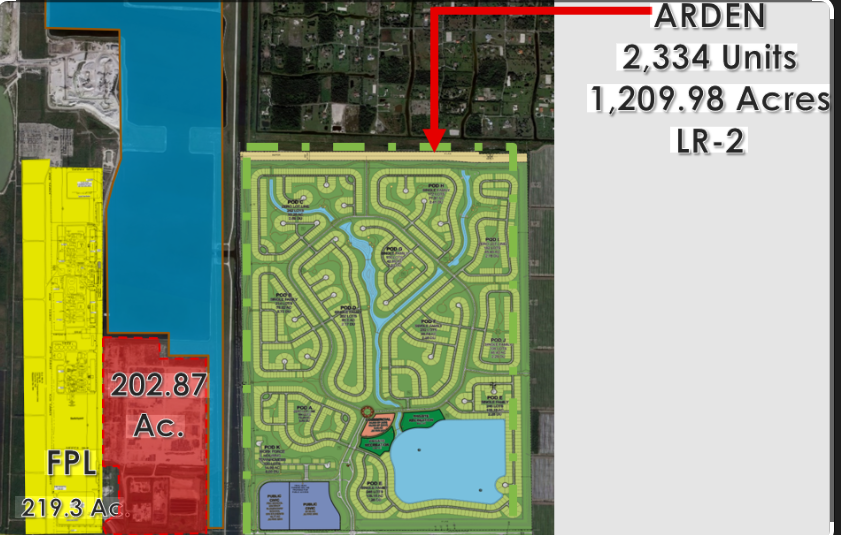
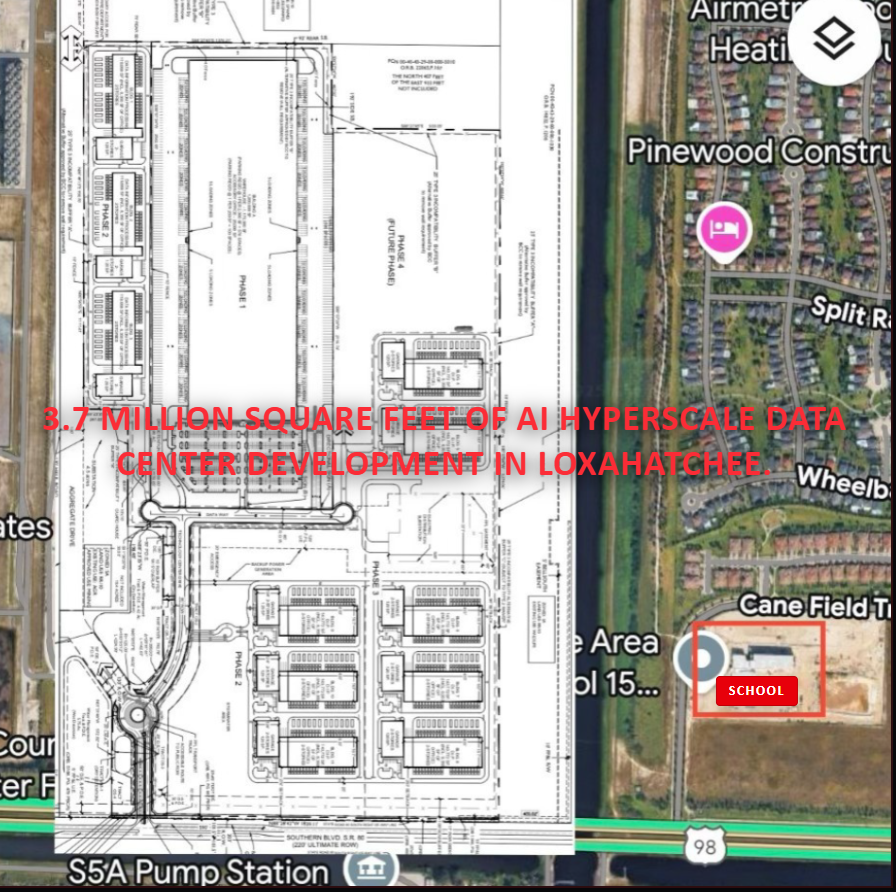
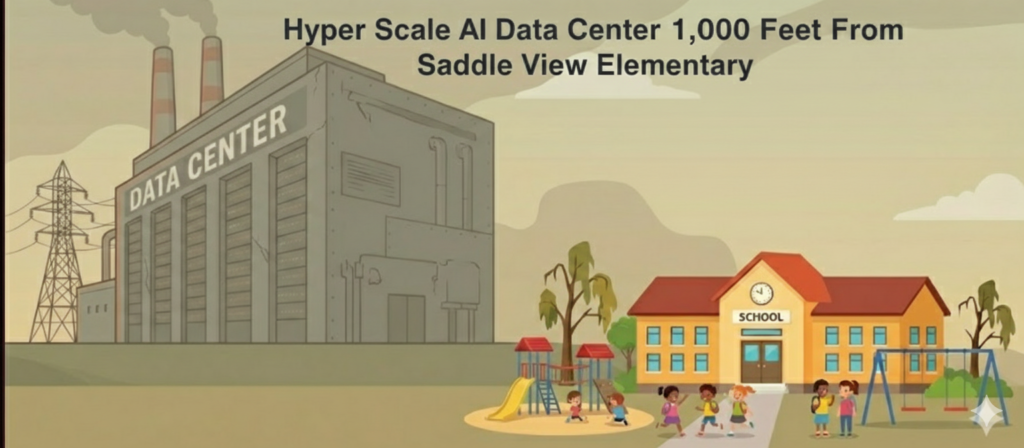
What is a Hyperscale Campus↑ Top
What A Hyperscale Campus Means↑ Top
A hyperscale data center campus is not a normal office project. It is usually a large industrial site built around server halls, cooling systems, substations, backup generators, topped off with security fencing, heavy utility infrastructure and a shit load of smog. These facilities will run all day, every day, and the impacts will go miles past the property line. The main issues are power demand, water use for cooling, constant deafening equipment noise, diesel generator testing, air pollution, and the pressure placed on local utilities. And can you imagine your property value with one of these next door?
The health concerns are tied mostly to what supports the data center, not the computers themselves. Diesel backup generators can release fine particles and nitrogen oxides, which are linked to asthma, heart disease, and other respiratory risks. Cooling systems and generators can also create noise that nearby residents and schools may hear during normal operation or testing. Before approval, the county should require clear public numbers for projected power demand, water demand, generator count, generator testing schedule, emissions, noise levels, and emergency operations. And then after they look at them, they should just say fuck no since its right next to where people live!
Power Demand
Modern hyperscale data centers are among the largest electricity users in the country. The U.S. Department of Energy and Lawrence Berkeley National Laboratory reported that data centers used about 4.4% of all U.S. electricity in 2023 and could reach between 6.7% and 12% by 2028.
Questions for Project Tango:
- How much electricity will the campus require?
- Will new substations or transmission infrastructure be needed?
- Could local ratepayers absorb future infrastructure costs?
Source: U.S. Department of Energy / Lawrence Berkeley National Laboratory
Water Consumption
Many hyperscale data centers use large amounts of water for cooling. Research from Lawrence Berkeley National Laboratory and the Environmental and Energy Study Institute shows that some facilities can consume tens of millions of gallons annually, with larger facilities potentially exceeding 100 million gallons per year.
Questions for Project Tango:
- How much water will the campus use each year?
- What cooling technology will be used?
- How would drought conditions affect operations?
- What impact could demand have on local water resources?
Sources: LBNL Water Efficiency | EESI Data Centers and Water
Air Quality
Data centers do not usually produce major emissions during normal operation. Most air quality concerns involve backup diesel generators used during outages and routine testing.
The World Resources Institute notes that diesel generators can emit particulate matter and nitrogen oxides, pollutants linked to respiratory and cardiovascular health risks.
Questions for Project Tango:
- How many backup generators are planned?
- How often will they be tested?
- What emissions controls will be required?
- Will air permits be required?
Sources: World Resources Institute | EPA Data Center Air Resources
Noise
Hyperscale campuses can operate 24 hours a day. Noise concerns usually come from cooling equipment, large fans, mechanical systems, substations, and backup generator testing.
Questions for Project Tango:
- What are the expected noise levels at the property line?
- How close are the nearest homes and schools?
- How often will generators be tested?
- Will the county require a public noise study?
Jobs & Economic Benefit
Data center projects often produce large numbers of temporary construction jobs but fewer permanent jobs once operating. Any public benefit claim should separate construction jobs from long-term local employment.
Questions for Project Tango:
- How many permanent jobs are promised?
- What wages will those jobs pay?
- How many will go to local residents?
- Are tax breaks or public incentives being offered?
- What public infrastructure costs could be required?
How Did We Get Here?↑ Top
Project Tango did not emerge in a vacuum. The proposal moved through Palm Beach County’s planning and review process while details about the project’s end user and ultimate ownership remained limited.
One issue that attracted public attention was the possibility that future data center development on the property could proceed through administrative approval rather than additional public hearings. According to public reporting, a separate proposal involving the same property could qualify for administrative review if certain approvals are granted. If that occurs, future phases of development may not require the same level of public participation as the original application.
Whether that outcome ultimately occurs remains to be seen. What is clear is that decisions made during the current approval process could shape what is allowed on the property for years to come.
Companies and Landholders
↑ Top
PBA Holdings
PBA Holdings, Inc. and Palm Beach Aggregates LLC
PBA Holdings acquired roughly 4,000 acres of former sugarcane land in February 1993 for $13.5 million and mined rock for decades.
Florida corporate filings list Enrique A. Tomeu (president), Michael S. Klein, W. Phillips Jr., J. Patrick McMullen, Peter Grossman and Albert/Alberto Moragues as directors/officers. The company shares a Loxahatchee address with its operating subsidiary Palm Beach Aggregates LLC. Jones Foster Service acts as registered agent.
In February 2023 PBA Holdings sold approximately 60 acres at the entrance of its property to WPB Logistics Owner LLC (an affiliate of TPA Group) for $36 million. PBA retains roughly 127 acres for its data center plan.
PBA’s data center proposal originally sought ~1.8 million sq ft of data center space plus warehouses. Facing opposition, project manager Ernie Cox pledged to reduce data center space to ~1 million sq ft and add a 216 000 sq ft utility building while increasing warehouse space. The county’s 2022 Future Land‑Use Amendment report limited the site to 2.79 million sq ft of warehouse and 0.49 million sq ft of light industrial and required at least 200 000 sq ft of uses leveraging adjacency to FPL’s energy plant.
C‑51 Reservoir Phase 1: Palm Beach Aggregates partnered with the South Florida Water Management District (SFWMD) to convert mined pits into a 14 000 acre in ground reservoir. The project was structured as a public and private partnership. Interested local utilities and PBA would share capital and operating costs. This reservoir, along with proposed Phase 2, provides alternative water supply for Broward and Palm Beach utilities and demonstrates PBA’s role in mining‑to‑reservoir infrastructure.
The F Minus lobbying database lists multiple firms representing Palm Beach Aggregates, including Arrow Group Consulting, Flagler Strategies and P5 Group. Campaign‑finance records show PBA Holdings and Palm Beach Aggregates made numerous contributions to Palm Beach County officials and state political committees
WPB
WPB Logistics Owner, LLC is an affiliate of the Atlanta-based TPA Group, which is heavily invested in commercial real estate development in Florida.
Co‑owner of part of the Central Park Commerce Center. The Atlanta‑based TPA Group purchased 60 acres of the PBA property in February 2023 for $36 million with a seller loan. The company filed a separate site plan in April 2026 proposing four separate 250 square foot data center buildings (~1.15 million sq ft) with outdoor generator yards and water chiller facilities.
TPA’s chairman J. Bradford Smith oversees strategy and previously founded Resource Real Estate Partners. He sold part of his service business to CBRE in 2012. The WPB Logistics parcel’s contact on county records lists Smith’s Atlanta address.
Florida Crystals, Big Sugar
Major landowners and political actors in Palm Beach County. Both Florida Crystals (Fanjul family) and U.S. Sugar own vast sugarcane tracts and have been involved in reservoir and mining proposals.
tA Palm Beach Civic Association profile notes that Pepe Fanjul Jr., co‑president of Florida Crystals, serves on the boards of Palm Beach Aggregates, ASR Group, the Sugar Association, and other Fanjul companies. The Central Palm Beach County Chamber of Commerce lists Ryan Duffy, U.S. Sugar’s communications director, as a chamber trustee alongside Enrique Tomeu.
Phillips Infrastructure
Phillips & Jordan, Inc. / Phillips Infrastructure
Heavy‑civil construction firm involved in mining and reservoir projects. It is the contractor for the Southland Water Resource Project and previously partnered with PBA on the C‑51 reservoir.
Transparency USA data shows Phillips & Jordan gave more than $356 000 to Florida political figures and committees, including $100,000 to state senator Jim Boyd, $50,000 to state senator Ben Albritton, and contributions to multiple political committees and the Florida Republican Senatorial Campaign Committee.
While Enrique A. Tomeu serves as the CEO of Palm Beach Aggregates, PBA Holdings, Inc. officially lists J. Patrick McMullen and W. Phillips Jr. on its board of directors/officers.
Other Landholders
Central Park Commerce Center Master Association: Holds common areas and infrastructure parcels within the MUPD. County records list it as an owner in the Project Tango application.
Business Leaders↑ Top
Enrique A. Tomeu
Enrique A. Tomeu
President of Palm Beach Aggregates LLC and PBA Holdings, president of Siboney Contracting Co., and board member of the Economic Council of Palm Beach County. Listed as a Chamber Trustee of the Central Palm Beach County Chamber.
Son of Enrique J. Tomeu, founder of Siboney Contracting; he expanded the firm and purchased a rock quarry before creating Palm Beach Aggregates.
Serves alongside U.S. Sugar’s Ryan Duffy on the chamber board, indicating close ties between the aggregates and sugar industries. Campaign‑finance records show donations from his companies to multiple county commissioners (e.g., Sara Baxter, Marci Woodward, Maria Sachs, Gregg Weiss) and to state committees such as the Florida Republican Senatorial Campaign Committee.
Michael S. Klein
Michael S. Klein
Director of PBA Holdings. Based in Seattle, limited public footprint but part of the PBA governance structure.
W. Phillips Jr. and J. Patrick McMullen
W. Phillips Jr. and J. Patrick McMullen
Vice‑president and secretary/treasurer of PBA Holdings respectively. Both share a Knoxville address linked to the Phillips Companies (Phillips & Jordan parent). This highlights the Tennessee construction firm’s stake in Palm Beach Aggregates and suggests cross‑ownership between the mining/reservoir and heavy‑civil sectors.
Peter Grossman
Peter Grossman / Ogden CAP Properties
Director of PBA Holdings. Provides a link to Ogden CAP Properties and the Milstein family in New York, indicating institutional real‑estate investment in the project. Opponents of Project Tango highlighted his involvement as evidence that PBA’s ownership extends beyond local actors.
Albert Moragues
Albert (Alberto) Moragues
Vice president/secretary of Palm Beach Aggregates and assistant secretary of PBA Holdings. Works for both the mining company and the holding company. Although that is almost standard in the construction industry these days. Any company with sizable land or equipment investment will put a lot of that in a holding company.
Ernie Cox
Ernie Cox
Attorney/project manager for PBA Holdings. Founder of Family Lands Remembered (an environmental consulting firm). He has represented PBA in town‑hall meetings and promised to downsize the data‑centre proposal. Previously involved in water‑storage projects, he also acted as a consultant for the Southland Water Resource Project.
This article shows Ernie Cox representing PBA as their lawyer.
J. Bradford Smith
J. Bradford Smith
Chairman of TPA Group and principal contact for WPB Logistics Owner LLC. Has decades of experience in real estate development; his firm has built other data center parks (e.g., Newton County Technology Park, Project Marvel)
Pepe Fanjul Jr.
Pepe Fanjul Jr.
Copresident of Florida Crystals and a board member of Palm Beach Aggregates. Serves on numerous sugar industry boards and civic organizations. His dual role illustrates the direct link between Big Sugar and Palm Beach Aggregates.
Ryan Duffy
Ryan Duffy: U.S. Sugar’s communications director, listed with Tomeu as a chamber trustee.
Local Government
↑ Top
Sara Baxter
Sara Baxter – District 6 (Mayor)
District: Represents the western area containing Project Tango. As mayor in 2025–26 she chaired the BCC during hearings on the data center proposal.
Donations: PBA Holdings donated $10 000 to her political committee Friends of Sara Baxter in November 2025; Related Southeast (developer Stephen Ross) donated $25 000. She denied that contributions influenced her and said she would oppose the project if residents’ concerns persisted.
Actions: Sponsored postponements to allow more study of generator noise, water use and economic benefits. Under her leadership the BCC deferred votes multiple times.
Marci Woodward
Marci Woodward – District 4
Role: Commissioner since 2022. Received at least $1 000 from Palm Beach Aggregates in county donation records and $5 000 to her committee Friends of Marci Woodward according to state‑level data from Transparency USA. She has not stated a public position on the data center but sits on a board that will vote.
Gregg Weiss
Gregg Weiss – District 2
Role: Commissioner representing central coastal district. Received multiple contributions from PBA Holdings, Palm Beach Aggregates and Florida Crystals (e.g., $500 from PBA Holdings in 2018 and $1 000 from Palm Beach Aggregates in 2021). Serves on water and infrastructure committees.
Joel Flores
Joel Flores – District 3
Role: Newly elected commissioner (2024). Has not yet voted on Project Tango but his district covers parts of West Palm Beach. Donation records show contributions from Palm Beach Aggregates to previous District 3 commissioner Mack Bernard.
Maria Sachs
Maria Sachs – District 5
Role: Commissioner whose district includes suburban and agricultural areas. Palm Beach Aggregates donated $1 000 to her campaign in 2020 and again in 2024. She often questions infrastructure impacts and affordable‑housing obligations in land‑use hearings.
Bobby Powell Jr.
Bobby Powell Jr. – District 7
Role: Commissioner representing parts of Riviera Beach and western communities. Received $1 000 donation from Palm Beach Aggregates in 2024.
Timeline: Project Tango and Related Local Fights↑ Top
1993: PBA Holdings acquired the western Palm Beach County property later tied to Palm Beach Aggregates, C-51 Reservoir, Central Park Commerce Center, and Project Tango.
2006 onward: The C-51 Reservoir began moving through regional water planning. The project involves Palm Beach Aggregates property and later Phillips work on reservoir construction.
2016: Palm Beach County changed the land use near the Palm Beach Aggregates rock mines and FPL power plant from rural residential to Economic Development Center, allowing warehouse, light industrial, and data-related uses.
2023: WPB Logistics Owner, tied to TPA Group, bought 60 acres from PBA Holdings for a warehouse project within Central Park Commerce Center.
July 1, 2024: Phillips & Jordan submitted the Southland Water Resource Project proposal. The project involved Florida Crystals, U.S. Sugar, Phillips & Jordan, mining, and future water storage.
January 30, 2025: Palm Beach County approved changes for Central Park Commerce Center. The owners listed in county records include PBA Holdings, WPB Logistics Owner, and Central Park Commerce Center Master Association. The agents listed include Carlton Fields and WGI.
May 2025: County commissioners approved zoning for Southland. Stet reported the project covered 13.5 square miles of sugarcane land, involved Florida Crystals, U.S. Sugar, and Phillips & Jordan, and generated more than 7,000 emails.
Late 2025: PBA Holdings returned with Project Tango, seeking a larger data center footprint at Central Park Commerce Center.
December 2025: Project Tango reached the zoning process. Public opposition grew around the size of the project, the unknown end user, power and water demand, industrial noise, backup generators, and proximity to Saddle View Elementary.
February 2026: Sara Baxter held a town hall on Project Tango and said she opposed it. Reporting also noted campaign contributions from Project Tango landowners and questions about whether her public opposition could affect her ability to vote in a quasi-judicial hearing.
February 2026: A separate West Palm Beach issue drew scrutiny when residents near 2032 N. Dixie Hwy said a stalled construction site had blocked their street for more than a year. The issue was not tied to Project Tango, but it became another example of residents asking why local enforcement moved slowly after a private project stalled.
April 2026: Palm Beach County confirmed it had no plans to restore part of Singer Island’s eroded shoreline that year. Residents raised concerns over property values, tourism, and long-term erosion.
April to May 2026: The Town of Palm Beach’s Mid-Town Beach Renourishment project faced weather delays, beach access closures, and schedule extensions.
April 2026: West Palm Beach Mayor Keith James paused the proposed downtown waterfront park after public backlash. The plan involved Related Ross and raised concerns over E.R. Bradley’s, Flagler Drive, private meetings, and public process.
April 2026: TPA Group / WPB Logistics submitted a separate data center proposal for its portion of the Central Park Commerce Center site. Stet reported the proposal could potentially move through administrative review instead of a public County Commission vote.
May 2026: Reporting showed two separate data center proposals tied to the same overall site. PBA Holdings said Project Tango was separate from the TPA / WPB Logistics application.
June 2026: Sara Baxter left the county commission race and entered the congressional race. Project Tango remained unresolved, with the larger question still unanswered: how much of this land can become data center space, and how much public review will future phases receive?
The pattern is not that every project is connected. The pattern is that major land, water, beach, and development decisions keep putting the public behind developers, landowners, consultants, and political insiders who often know the plan long before residents do.
Sources & Supporting Documents↑ Top
Project Tango Records
Company Records
Southland Water Resource Project
Political Records & Local Officials
Related Local Development Controversies
Palm Beach County Corruption History
Data Center Environmental Sources
These links are provided so readers can review the underlying records, reporting, and public documents directly.
Project Tango Connection Chart↑ Top
PBA Holdings / Palm Beach Aggregates
- Connected to the Central Park Commerce Center property.
- Linked to the C-51 Reservoir through Palm Beach Aggregates land.
- Appears in the Project Tango record.
Phillips & Jordan / Phillips Infrastructure
- Connected to C-51 Reservoir construction.
- Connected to Southland Water Resource Project reporting.
- Phillips-linked names also appear in PBA-related records.
TPA Group / WPB Logistics
- Owns part of the same Central Park Commerce Center site.
- Submitted a separate data center proposal.
- Reporting says it may qualify for administrative review.
Palm Beach County
- Zoning Commission reviewed Project Tango changes.
- County Commission postponed the vote after public opposition.
- Future approvals could affect what happens on the site later.
Sara Baxter
- Represented western Palm Beach County.
- Held a Project Tango town hall and publicly opposed the project.
- Later left the county commission race to run for Congress.
Southland Water Resource Project
- Involved Florida Crystals, U.S. Sugar, and Phillips & Jordan.
- Combined mining and future water storage plans.
- Approved after major public pushback.
C-51 Reservoir
- Located on Palm Beach Aggregates property.
- Promoted as a regional water supply project.
- Connects land, mining, reservoir, and infrastructure interests.
Residents / School Board
- Raised concerns about noise, water, power, traffic, and health impacts.
- Opposition increased because of the project’s proximity to Saddle View Elementary.
- Public details about the final user remain limited.
This chart shows documented overlaps and related projects. It does not claim every party acted improperly. The purpose is to show where the same land, infrastructure, development, and political circles intersect.
Sara Baxter and the Congressional Race↑ Top
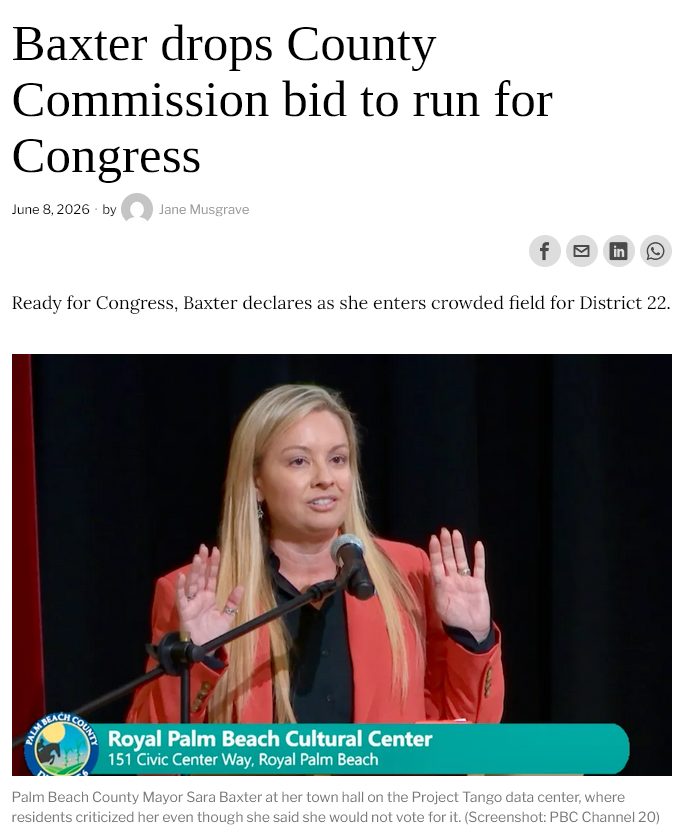
Sara Baxter represents District 6, the western Palm Beach County district where Project Tango is proposed. She hosted the February 2026 town hall on Project Tango and opened the meeting by saying she would not vote for the data center. WLRN reported that residents still criticized her at the meeting, partly because the project had already advanced far enough to require a major public fight.
In June 2026, Baxter dropped her County Commission reelection campaign and filed to run for Congress in Florida’s newly redrawn 22nd District. That move matters because Project Tango remains unresolved. If Baxter leaves county politics, western Palm Beach County residents may face future votes, delays, or administrative approvals without the same elected official who publicly opposed the project.
WLRN/Stet: Baxter drops County Commission bid to run for Congress
https://www.wlrn.org/government-politics/2026-06-08/baxter-drops-palm-beach-county-commission-bid-to-run-for-congress Stet: Baxter drops County Commission bid to run for Congress
https://stetnews.org/2026/06/08/baxter-drops-county-commission-bid-to-run-for-congress/ WPTV: Baxter announces run for newly drawn District 22
https://www.wptv.com/news/palm-beach-county/palm-beach-county-commissioner-sara-baxter-announces-run-for-congress-in-newly-drawn-district-22 WLRN: Project Tango town hall / residents opposed
https://www.wlrn.org/government-politics/2026-03-03/palm-beach-county-residents-only-want-one-answer-on-data-center-no Palm Beach County District 6 biography
https://discover.pbc.gov/countycommissioners/district6/Pages/Biography.aspx