
I moved to Colorado many moons ago. After the weed craze had simmered down, and long before COVID helped initiate one of the largest wealth transfers we have ever seen. I had just had a bad run of looking for work where I lived, my parents had sold a business they had and were talking about moving to Florida, and I had two childhood friends already living here. So I said screw it. I had grown up around the construction industry and quickly and easily found a job in said industry in beautiful Colorado. So I moved out, hung out with my buddies going to the now defunct Grateful dead themed bars (Jay really was a piece of shit, huh?), and worked my ass off. Coming from growing up in a small to mid sized town in the Appalachian foothills to Denver was so awesome to me. There was an actual music scene, we had extensive and beautiful outdoor recreation, and community events that actually introduced me to like minded individuals instead of guys my age seeing who could get their truck to roll the most coal.
I thought I had hit the jackpot. Me and my buddies moved into a beautiful house together, split the rent and bills, and were living great. We were paying 2100 a month for a 4 bedroom 2 bath house, with a nice backyard, in a quiet working class neighborhood. And we thought we were overpaying, but it was okay because we were affording it and enjoying it. Two years later, I had moved to another company and was advancing my career. My buddies however were thinking about moving back to Kentucky. Covid had hit their work hard, and their social life harder. I had my head down and was so focused on work I didn’t even notice the rest of the world has stopped, I was an essential employee. So my buddies moved back home, I found a couple of room mates to help me keep the house, and work sent me out of state. The pandemic restrictions lifted, life kept moving forward, one of my room mates got addicted to heroin, the other one had a mental breakdown, and I was moving out of the house.
The fellow who owned the home I was renting was actually a really nice guy. He offered to sell the house to me right at market value at the time, no bidding war, no dealing with realtors paying third parties. I just couldn’t accept the price. I knew Colorado was more expensive than where I had come from, but I had lived downtown Lexington Ky, I had lived in Detroit. I had lived in Florida. From cheap to expensive places all over, I couldn’t justify half a million dollars for the house I had just been paying 2100 a month for in rent. It had a swamp cooler, no actual A/C. Bedrooms were decent, but no master bath and smaller showers. To make it into a home work 500k it really felt like it needed a lot of renovations to me. Don’t get me wrong I thought it was a great home for me and my ass hole buddies to rent but certainly not worth half a mill.
Well the market was moving while I was working and I hadn’t noticed over the past 5 years housing had gone up a LOT and wasn’t stopping its upwards climb any time soon.
Prices aren’t just high
Colorado has more than one issue influencing high prices. There is a well documented state wide housing shortage. Mortgage rates are relaxing but have been at a disadvantage rate for a while, especially with the prices that homes are currently at. Local zoning still reserves large amounts of land for low-density housing, and developers would rather plop a 600k cookie cutter house down than try and build actual starter homes. If we did have medium density zoning or more relaxed low density zoning we could maybe see some well designed villas with decent square footage, but what I have seen has been disappointing condos and shitty cardboard 5 bedrooms. I wouldn’t even mind the higher prices if the houses were actually well built and interesting but that’s an entirely different story.
What I have seen has been pretty typical across the country though. Developers and realtors associations have taken advantage of relaxed campaign finance laws the same way that large corporations and defense contractors have been doing. They are getting access to our representatives in a way that only money can buy, and the average working class citizen suffers for it, while the executives at the top are seeing the largest market shifts in recorded history.
At the time of writing this Redfin shows the median home price in Colorado at 634,620$
Zillow shows $543,270
The Fred says the Per Capita PErsonal Income in Colorado is 86,181$
Using Redfins how much home can I afford calculator with that salary and 500$ a month of debts they say to have a comfortable payment you dont want to go over 295,181$
I have relatively little debt, but a lot of people will have a higher number than that these days. With rising healthcare costs, vehicle maintenance, childcare, elder care its easy to accumulate a debt payment. And those payments will drive your spending limit for a home down quickly if you want to be able to have a comfortable mortgage rate.
Even at 120k a year, redfin suggests you cap your home price at 382k$ With median home price at 634 its going to be damn hard to enter the housing market as a first time buyer. And please don’t give me the boomer response that you need to look at a lower cost home, that it’s a starter and you can upgrade.
Developers are building bigger and more expensive homes by default.
This CPR article states
“It’s not as if prices are falling off a cliff. The median home price in Denver is $605,000, according to DMAR. That’s slightly lower than the peak in 2022, but still out of reach for many families.”
Even in areas that expect to have lower home prices
“The boom in real estate values early in the decade spread west to Grand Junction, too, says Ann Hayes, a real estate broker in the area since the 1990s. She says median prices have basically doubled during the past decade to more than $400,000.”
You can’t even find fixer uppers anymore in a price range that makes sense, homes that need repairs are often needing a lot of repairs. Otherwise the owners would be fixing it themselves and then selling it. With the way the market is currently its easy to profit off of a property, especially if you bought it pre or early on in the housing boom.
So the median home price is just outside of what a person with a good salary can reasonably afford.
Home builders are blaming labor shortages and material costs for rising prices.
“The rise in building material costs is harming housing affordability as the cost of softwood lumber, steel, aluminum and other imported materials and equipment exacerbate price volatility and drive up housing costs.” – National Association of home builders
But there’s more to it than just that. If it was just material and labor an easy fix would be to build smaller more efficient homes. This would also help sell homes more quickly since first time buyers are looking to build equity, not to jump into a 5 bedroom with high upkeep costs.
Colorado First-Time Homebuyer Pressure Points
Colorado affordability metrics that shape the market for first-time buyers.
| Metric | Value |
|---|---|
| Median monthly home payment growth, 2017 to 2023 | 71% |
| Median home price growth, 2017 to 2023 | 26% |
| Cost-burdened renters statewide | 46.8% |
| Cost-burdened homeowners statewide | 21.5% |
| Denver hours of work needed for a mortgage, 2015 to 2025 increase | 94% |
Sources: Colorado Housing and Finance Authority; Common Sense Institute Colorado.
Local Politics Matter
Colorado has historically left zoning mostly to local governments. Which can mean housing and rent prices can vary more from city to city and county to county than a state that has higher level policy influencing decisions. Littletons zoning webpage says that zoning is the main tool the city uses for controlling building height, parking, setbacks, and open space. They claim the city’s planning framework is driven by the Unified Land Use Code and to provide compatability of neighboring land uses.
Littleton also uses PL-O
Planned Development Overlay. A fancy way of saying its an exception to the rules. Unique Zoning Regulations. Often created for whole subdivisions, created by developers, and approved by the City Council. This isn’t unique to Littleton. These exceptions to the rules are normal across the state. Developers have a lot of sway with local government. And they spend a lot of money on them to get that sway.
In 2024 Colorado enacted laws that require many jurisdictions to allow accessory dwelling units in low density housing areas, it prohibited occupancy caps based on familial relations ( A horribly outdated standard since young people are getting married less and less), and restricted minimum parking mandates, as well as housing opportunity zoning for communities that were built around public transit.
Many Littleton neighborhoods fought back against these changes.
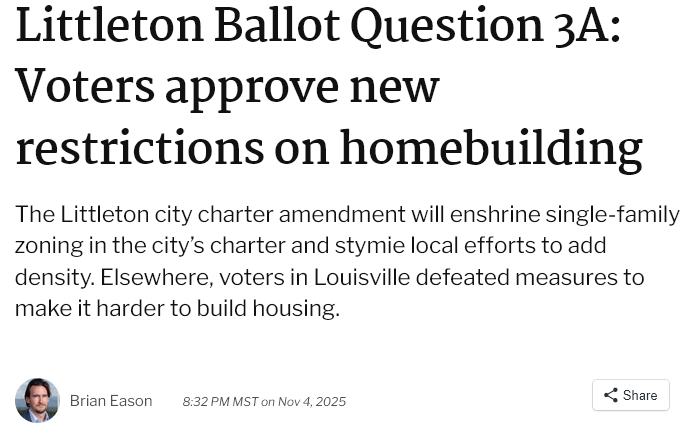
So it’s not that people don’t want to get into the housing market. It’s not even that developers don’t want to build homes. But everyone is gaming for the angle that makes them the most money. Developers would rather build larger single family homes because they know they will sell with the shortage of housing in the market. Current home owners want to keep prices high, they don’t want to see their investment lose value. Which is more understandable if you bought in the last 5 years, but families who bought their home in 95 have seen nothing but enormous equity growth and its a little harder to defend policy that makes it harder for younger generations to become homeowners just so you only make 400k on your house instead of 600k.
Colorado Home Prices vs. Inflation and Income
Compared to Colorado’s 2000 median home value of $166,600.
Colorado’s 2000 median home value was about $166,600.
If that price had only followed Denver-area inflation, it would be around $322,000 today.
If it had followed Colorado household income growth, it would be around $337,000 today.
But the actual recent Colorado home value is closer to $539,000.
That means Colorado homes are roughly $200,000 to $220,000 higher than they would be if home prices had stayed tied to inflation or income growth.
Political Spending
Colorado Real-Estate Money: PACs & Associations
Groups spending, endorsing, or influencing Colorado housing politics.
Colorado Realtors PAC
TRACER lists the purpose as electing candidates who support REALTOR issues.
2026 cycle: $56,230 spent, $51,648 cash left.
View TRACER filingColorado Association of Realtors
Published 2026 endorsed state legislative candidates.
Names include: Terri Carver, Andrés Carrera, Sean Camacho, Chris Floyd, Ava Flanell, Jena Griswold, Michael Bennet.
View endorsementsColorado Association of Home Builders
Published a 2024 voter guide endorsing state and congressional candidates.
Names include: Sean Camacho, Rebekah Stewart, Jacque Phillips, Judy Amabile, Chris Hansen, Jason Crow, Brittany Pettersen.
View voter guideHBA of Metro Denver
Said its endorsed candidates won 13 of 15 primary races and that it would continue endorsements and contributions.
View HBA reportApartment / Contractor Interests
Colorado Sun reported links involving Apartment Association of Metro Denver, Associated General Contractors of Colorado, and One Main Street Colorado.
View Colorado Sun reportColorado Election Spending Tied to Housing Politics
Examples of candidate backing, outside spending, and races where real-estate interests had a stake.
Colorado legislative primary super PAC spending
Colorado Sun reported nearly $5.7 million in state-level super PAC spending in 2024 legislative primaries, with stakes tied to housing, taxes, environmental rules, and worker/consumer protections.
Read the reportMost outside money hit Democratic primaries
About 80% of the state-level super PAC money went into Democratic contests, where future housing and regulation votes were part of the political fight.
Read the Colorado Sun breakdownA Whole Lot of People for Change
The group spent over $1 million backing nine more moderate Democratic candidates, including candidates such as Cecelia Espenoza, Michael Carter, Rebekah Stewart, Jacque Phillips, Judy Amabile, and Ethnie Treick.
View sourceDenver mayor race media spending
Denverite reported that A Better Denver, an independent expenditure committee supporting Kelly Brough, spent $262,368 on media buys and was backed by developers and construction interests.
Read Denverite reportDenver mayor race canvassing
The same committee also spent $54,375 on canvassing early in the race, with donors including construction, apartment, and development-linked interests.
View donor contextThat’s a lot of money spent on campaigns to influence who is controlling the rule book. With the state already being in a housing shortage, prices are going to go up. By then having political positions held by people who are friendly with builders, sellers, and apartment associations they can further control who is building what, and where, and how much it might rent for. It might seem like these things are minor compared to the economy as a whole, but they contribute to the economy as a whole as well. There has been a feedback loop in the US ever since citizens United where more money is going into political campaigns from corporations, companies, and associations to help influence laws/rules/regulations that will help them increase profit margins, where as they spend more money the next election to continue the cycle. Nobody wants to reduce overall costs. Even builders who would have benefited in the past from lower home costs by being able to sell more homes can profit more from a higher median. Especially in a country with a shortage. People have to have a place to live. Its a definitive need. IF there aren’t enough homes for sale on the market the ones there are will hold their value more steadily. So instead of building higher density, smaller more efficient and more affordable, they can build larger more expensive homes and maintain profit margins.
The labor and material shortage may contribute to that in a secondary way even. If there is a material and labor shortage you can stick to simpler home designs that require less labor to build. Instead of doing a four story with four individual units, you do single story, copy paste design from one house to the next, and each one of them will eventually sell. So instead of a building with 4 units and each unit generating 50k in profit you can sell a single family home for 400k that will make you 250k in profit. And the fact that you are maintaining inventory in the process also helps keep prices higher!
And I have always wanted my own home, I don’t want to hear my neighbors. I want some privacy. I am not against single family homes. But we can make them more affordable by getting everyone into a reasonable home whether that means they have a nice villa with a shared outdoor space, condos, an accessory dwelling like a cottage, or even apartment buildings. Reasonable and affordable homes that people can purchase and build equity will help everyone get the housing they need to live.
The smallest of elections
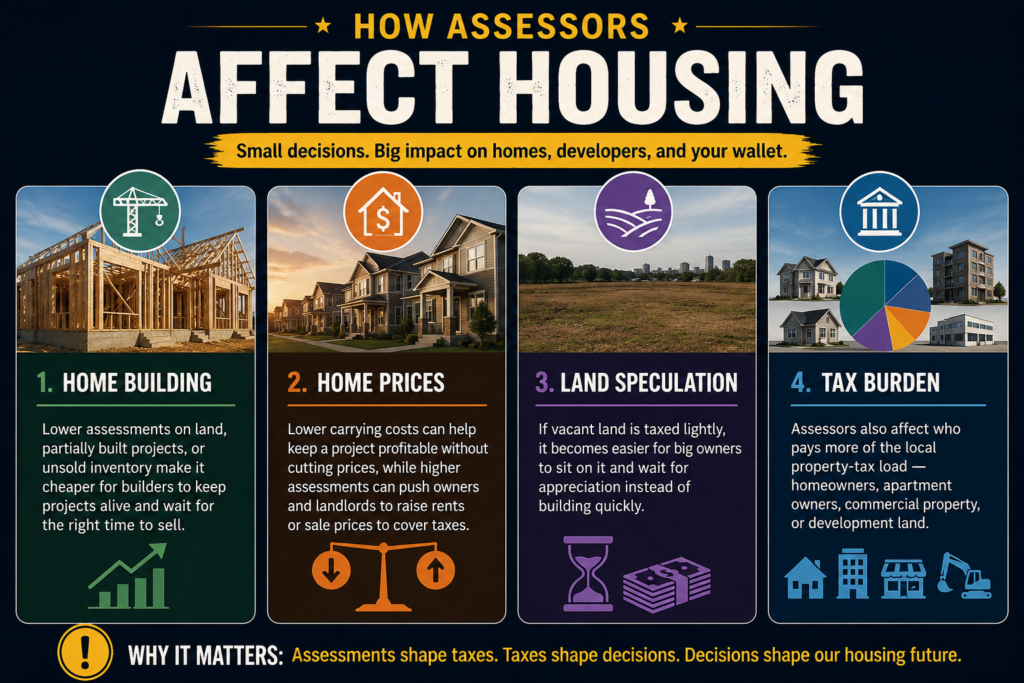
Big influence can come from smaller government positions. Most people focus in on county boards, mayoral races, the Governor. These titles demand respect and can generate a lot of influence over their constituents. A county assessor isn’t going to control when where how, or even IF, a subdivision is built and approved. But they can affect how expensive it is to sit on that land, build homes there, or rent units. And don’t even get me started on empty properties being held just to keep them off the market!
An assessor directly influences property taxes and carrying costs of land ownership and development. If an assessor is more friendly to developers and landlords and is willing to help them keep valuations lower that can make a mind boggling difference in how projects go. An assessor and quietly and discreetly influence millions if not tens of millions or hundreds, of dollars of tax exposure. While it makes the paper from time to time, these valuations often just happen without fanfare. An empty lot or a half built building being valued lower doesn’t strike most people as off until they think about it more deeply.
And county assessors don’t even need a lot of money injected into their campaigns typically. It’s a race that not a lot of people typically look at. From tracer I found some information about the Littleton Assessor election.

Compared to other races it’s just a drop in the bucket. So if a realtors group or developer wanted a friendly assessor to win a race they could easily inject another 20k into the race through personal donations, PACs, and industry friends. They wouldn’t even need to do anything shady, for them that amount of money could easily be donated just by talking to their buddies and saying lets support this person and each of them making a donation. In this case they have created a group called friends of PK where they can send the money first, and then give it to the candidate. This can help obfuscate where the moneys really coming from, and get around some donation limits. But its not even a lot in the world of political contributions. And that’s the truly interesting thing, for a position that can easily swing housing projects costs from red to black, it doesn’t take a lot of money to influence the election campaign.
State snapshot.
Colorado Real-Estate Political Money
Builders, Realtors, apartment owners, and development-linked groups backing candidates and shaping housing policy.
| Group / Candidate | Money / Activity | Who They Backed / Paid | Source |
|---|---|---|---|
| Colorado Realtors PAC | $56,230 spent in 2026 cycle so far | Terri Carver, Andrés Carrera, Sean Camacho, Jacque Phillips, Anthony Hartsook, Amy Parks, Jena Griswold, Michael Bennet, others | TRACER |
| Apartment Association of Metro Denver PAC | $42,719 raised / $39,675 spent through Mar. 31, 2026 | Jeff Bridges, Don Sheehan, Guyleen for Broomfield Mayor, Sweetland for Centennial, Michael Bennet, Robyn Carnes, Ryan Dwiggins | Transparency USA |
| Colorado Association of Home Builders / HBA network | Endorsement-heavy candidate-guide strategy | Sean Camacho, Rebekah Stewart, Jacque Phillips, Michael Carter, Anthony Hartsook, Judy Amabile, Lindsey Daugherty, Chris Hansen, Jason Crow, Brittany Pettersen, others | HBA Voter Guide |
| Dark-money / business moderate groups | $5.5M to $5.7M in 2024 legislative primary outside spending | Helped more moderate Democratic candidates defeat progressive candidates in legislative primaries | Axios Denver |
| Jacque Phillips | $6,200 from Realtor Small Donor Committee + $5,800 from Apartment Association small donor committee | Candidate received direct real-estate-linked support | Transparency USA |
| Julie McCluskie | $5,350 from Apartment Association small donor committee + $5,350 from Realtor Small Donor Committee | Candidate received direct real-estate-linked support | Transparency USA |
| Sean Camacho | Endorsed by Realtors and listed in Home Builders materials | Backed by both Realtor and home-builder-aligned organizations | Colorado Realtors |
| Kelly Brough, Denver mayor race | $262,368 media buys + $54,375 canvassing by A Better Denver | Supported by developer, construction, and apartment-linked interests | Denverite |
We already mentioned a few of these entities, but its worth looking at them again.
There’s a lot of money to be made and lost by influencing housing prices. And while Colorado has gone blue, that hasn’t seemed to really make peoples lives better in areas where it really matters. We can blame the federal government all day, and while they will certainly influence our situation, it doesn’t change it. Local politics matter, that’s why so much money gets spent on it.
Progressive candidates.
I am at a point where I see your typical republican and democrat candidates as two wings on the same bird. The difference between them is more like two apartment layouts in the same building than looking at houses in different neighborhoods. At the end of the day they would rather they didn’t ruffle feathers rather than make a large impact. And they are all backed by corporate money!
Here are some candidates that seem like they could be a refreshing change of pace away from the status quo we have been dealing with. If we have any chance of saving this country from itself we will have to get people into power that aren’t just rehashing the policies that have not worked for working class families for the past 50 years. ( Although the 90s I am told was a very high time where things were affordable, technology moved fast and was fun, and job growth was great)
Colorado Progressive Candidates
Progressive-backed candidates running in Colorado.
| Candidate | Race | Progressive Signal |
|---|---|---|
| Julie Gonzales | U.S. Senate | WFP + Denver DSA recommended |
| Melat Kiros | U.S. House CD-1 | WFP, DSA, Justice Democrats, Bernie Sanders |
| Amanda Gonzalez | Secretary of State | WFP + Denver DSA recommended |
| David Seligman | Attorney General | WFP + Denver DSA recommended |
| Iris Halpern | HD-6 | Denver DSA recommended |
| Neal Walia | HD-9 | Denver DSA recommended |
| Mandy Lindsay | HD-42 | Denver DSA recommended |
| Chela Garcia Irlando | SD-34 | Denver DSA recommended |
| Alex Ryckman | SD-21 | Denver DSA recommended |
| Andy Kerr | Jefferson County Assessor | Denver DSA recommended |
| Jessica Campbell | Arapahoe County Commissioner D2 | Denver DSA recommended |
| Leslie Summey | Arapahoe County Commissioner D4 | Denver DSA recommended |
Note: Melat Kiros has publicly framed part of her campaign around rejecting AIPAC support. Source
I had to add aipac on there because I see them as a huge strain on our economy, and a bad influence on candidates. Not sure why it’s so important for us to help a foreign country. One that seems to actually have active disdain for us as well, no matter how much money we waste on them.
Anyway I have never even considered myself a left leaning person. I have always thought of myself as a classic conservative.
Lets conserve our clean air, our public spaces and parks, preserve our wildlife, preserve our water ways, preserve our populace with proper education, preserve our ideals and communities by being accepting but encouraging people to actually mingle and share a culture that isn’t at war with itself.
I just don’t understand how so many people who claim they are Christian are messing up the part where we are supposed to Love Thy Neighbor.
I am not even against borders, the whole border debate wasn’t even a real thing until it was used to destabilize us. People that really wanted to come to the USA could come in reasonable numbers, we didn’t accept boats of males, and we gave real pathways for people to become citizens. Now Amazon can lay off 13k people the same year it gets 13k H1B visas approved. And those poor souls will have their ability to live here tied to that job now, so they will get used and abused and certainly underpaid.
Once again too much corporate influence. Not enough power to the citizens. Don’t even get me started on how our education has been undermined and hijacked six way to sunday to influence how people interpret the most basic aspects of civic duty and economy.
Anyway I have gotten way off topic at this point. Until next time.